








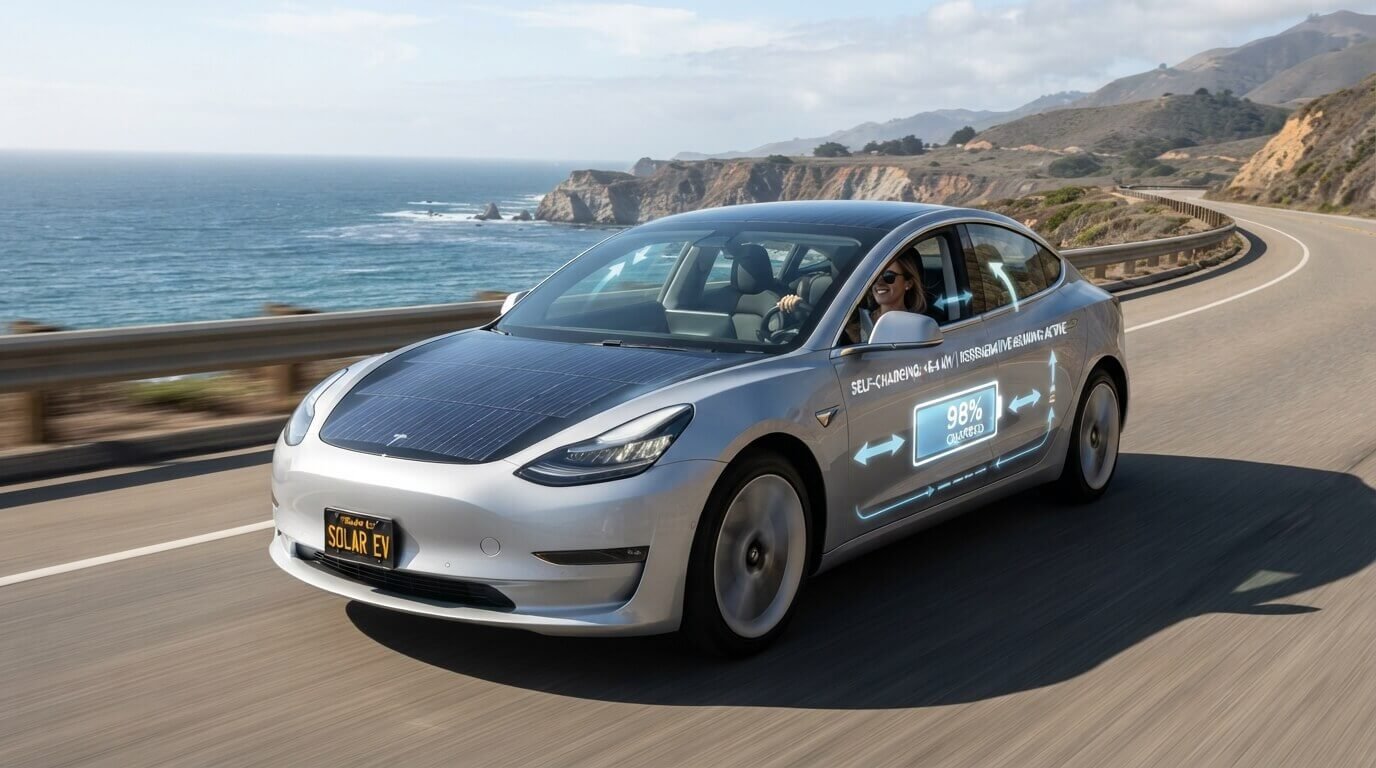
A car that has both a petrol engine and an electric motor, and which fills up its own battery while you are driving, this is what people call a self-charging hybrid. No plugging in required, ever. At Car Magazine, almost every week somebody asks us about this topic, so we decided to put together a guide that covers it properly: how the system works, how it is different from a plug-in hybrid, and, in 2026, which self-charging hybrids actually deserve your money.
Full hybrid or HEV (hybrid electric vehicle) is another name for a self-charging hybrid, and the battery gets charged in two ways: the petrol engine works like a generator, and regenerative braking turns kinetic energy from slowing the car into electricity. A wall socket or public charger is never needed for this. The electric-only range, though, is quite small, often less than a mile and only up to around 25mph, and this is really the main thing that separates it from a plug-in hybrid (PHEV).
How Does a Self-Charging Hybrid Car Work?
Inside a self-charging hybrid, you will find a normal internal combustion engine (ICE) working together with an electric motor and a battery that isn’t very large. Depending on how you are driving at any moment, the car’s system decides on its own whether to use petrol, electricity, or some mix of both.
There are two ways the battery gets topped up:
- The engine, used as a generator: a portion of what the petrol engine produces gets sent off instead to charge the battery.
- Regenerative braking: while coasting or slowing the car down, the electric motor switches roles and starts generating power, catching energy that would normally just turn into heat and be wasted, and putting it back into the battery instead.
Since plugging in is never part of the process, engineers keep the battery pack fairly small on purpose. That is also the reason why running on electricity alone only lasts for short stretches around town, and mostly at lower speeds.
Self-Charging Hybrid vs Plug-In Hybrid (PHEV): What’s the Difference?
Out of everything people ask about, this confusion comes up the most often, so here is how the Car Magazine team explains it in simple terms:
| Self-Charging Hybrid (HEV) | Plug-In Hybrid (PHEV) | |
|---|---|---|
| Charges via plug? | No | Yes |
| Electric-only range | Up to around 1 mile | 20 to 80+ miles |
| Battery size | Small | Large |
| Top electric speed | Around 25mph | 70mph and above |
| Best for | Short or urban trips, no home charger | Regular charging access, longer commutes |
| Running costs | Cheaper to purchase, steady fuel savings | Costs more upfront, but can be nearly as cheap as an EV to run if charged often |
Basically, when there is no home charger or nearby public charging point available to you, a self-charging hybrid still lets you save on fuel without any extra effort involved. But if charging regularly isn’t a problem for you, a plug-in hybrid tends to save more money in the long run.
Is a Self-Charging Hybrid the Same as an Electric Car?
Not really, and a lot of people get this wrong. Petrol is still the main fuel for a self-charging hybrid; the electric motor is only there to help out. A fully electric car, on the other hand, has no engine whatsoever, and it depends completely on a much bigger battery that only ever gets charged from the mains or a public charging network. You could say a self-charging hybrid sits somewhere in the middle, between an ordinary petrol car and a proper EV.
Are Self-Charging Hybrids Worth It?
Pros:
- You never have to search for a charging point or pay to use one
- Fuel economy tends to be genuinely good in real driving conditions, often 55 to 65mpg
- Running costs come in lower than a comparable petrol-only car
- Buying one usually costs less than an equivalent plug-in hybrid
Cons:
- The electric-only range is quite limited next to a PHEV or a full EV
- A number of critics feel the term “self-charging” makes these cars sound more electric than they really are
- Under harder acceleration, the CVT-type gearbox can get a bit noisy
Best Self-Charging Hybrid Cars in 2026
According to Car Magazine’s road testers, these models stand out among the self-charging hybrids currently sold in the UK:
- Hyundai Santa Fe: a strong pick for families who need seven seats
- Toyota Yaris Cross: if fuel economy in a compact SUV is your priority, this one delivers
- Honda Civic: great to drive, and built to a high standard
- Renault Clio E-Tech: small hatchback, plenty of style
- Dacia Bigster: roomy SUV that offers solid value
- MG3 Hybrid+: the most affordable self-charging hybrid you can buy right now
- Kia Sorento: quiet and comfortable, well suited to long drives
- Lexus LBX: compact but genuinely feels luxurious
(Every one of these cars has a full, in-depth review linked throughout this guide; check our best hybrid cars hub for the complete testing notes.)
Frequently Asked Questions
What does “self-charging hybrid” actually mean?
It simply means the car’s battery keeps itself charged while you drive, using the engine and regenerative braking, so there’s no need to plug it into any outside power source.
How far can a self-charging hybrid drive on electric power alone?
Usually not far, less than a mile, and only at fairly low speeds of up to about 25mph, after which the petrol engine has to take over again.
Do self-charging hybrids need to be plugged in at all?
No, not at all. That is really the whole point of them, everything is charged through the car’s own systems, and a plug is never involved.
Is a self-charging hybrid cheaper to run than a normal petrol car?
In most everyday driving situations, yes, self-charging hybrids give noticeably better fuel economy compared with an ordinary petrol car, especially when driving is mostly stop-start around town.
Which is better: self-charging hybrid or plug-in hybrid?
That really comes down to how easy charging is for you. If there’s no charger at home or at work, a self-charging hybrid makes more practical sense. But when charging is easy to access regularly, a plug-in hybrid will usually end up saving you more money over time.