








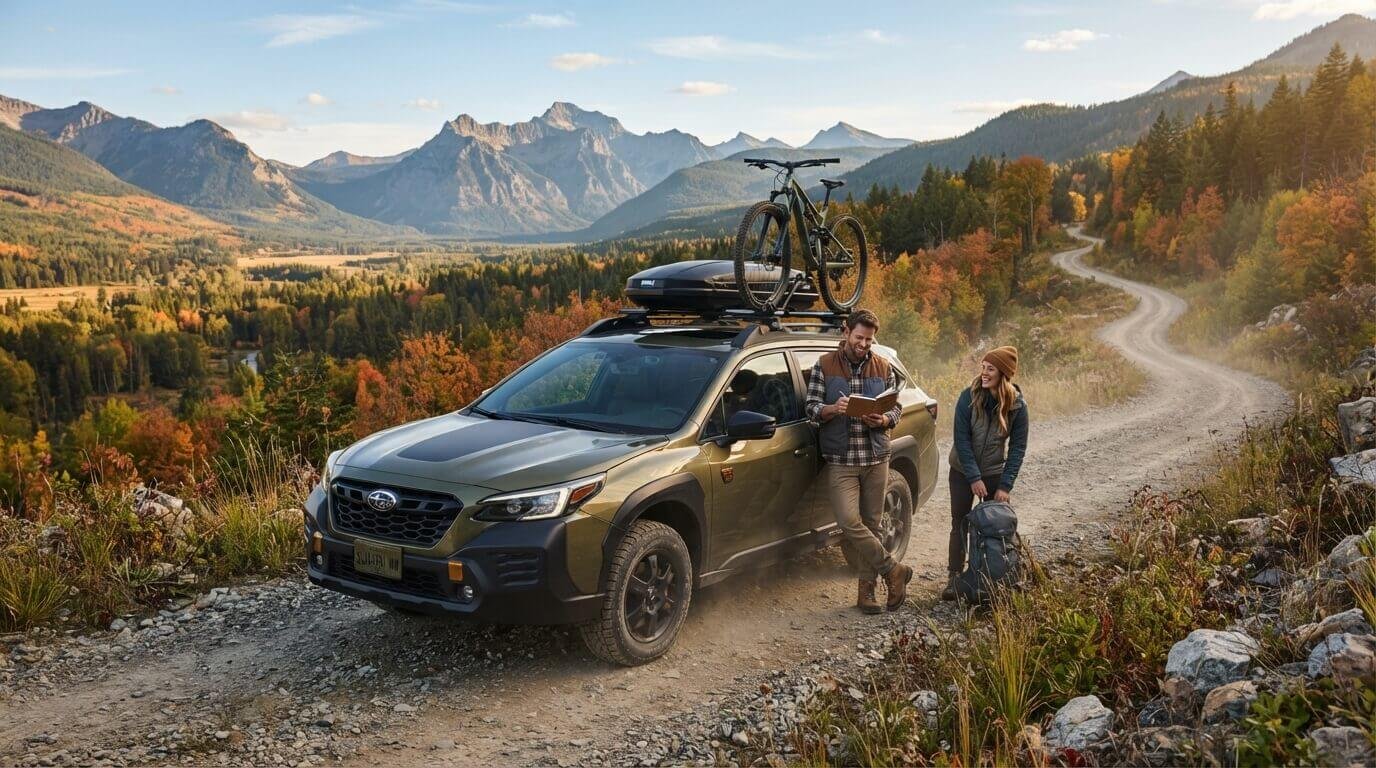
One thing is clear across most Subaru Outback reviews: this is a dependable, capable wagon-SUV, made more for families and outdoor life than for speed or luxury. Car-like handling meets SUV-style ground clearance here, together with standard all-wheel drive and a boxy, no-nonsense cabin built to survive years of everyday use.
In the market, the Outback occupies a somewhat unusual space. Looking like an SUV, it actually drives more like a raised wagon. For this exact reason, buyers wanting something rugged, yet not ready to commit to a full body-on-frame off-roader, keep placing it on their shortlists.
What Do Subaru Outback Reviews Say About the Engine and Driving Experience
Two engine choices are usually available on the Outback:
- A 2.5-litre naturally aspirated boxer engine, which gives smooth and predictable power for the daily commute
- A turbocharged 2.4-litre boxer engine, adding clearly more punch for overtaking, hill climbs, and merging onto highways
Both come paired with a Continuously Variable Transmission (CVT). Unlike a traditional automatic, this gearbox does not shift through fixed gears. Rather, it keeps adjusting so the engine stays running near its most efficient point. Some drivers, new to CVTs, notice a slightly different sound during acceleration at first, though most get used to it fast.
Out on the road, the steering stays light and easy in traffic, while the suspension remains soft enough for comfort, yet firm enough for winding roads without too much body roll.
Interior and Technology Highlights
Function, more than flash, is what the Outback’s interior is built around. In recent model years, the following can be found:
- A large touchscreen infotainment display, often together with a digital gauge cluster
- Wireless smartphone mirroring, working with both Apple CarPlay and Android Auto
- Heated front and rear seats, standard on most trims
- A spacious front console, made for phones, wallets, and other daily items
Solid build quality is a common description, with seats supportive enough to hold up well across long drives. On higher trims, leather upholstery, a sunroof, and upgraded audio get added, while the base trims stay simple and practical by design.
All-Wheel Drive and Off-Road Capability
Standard all-wheel drive comes on every Outback, a feature not so common at this price point. Power gets split evenly between all four wheels by this system, which helps reduce wheelspin and improve stability on wet, gravel, or snowy roads.
On higher trims, X-Mode is included, a driver-assist system adjusting throttle response and traction control for mud, snow, or steep descents. Close to 8.7 inches is the ground clearance, enough for light trail driving, gravel roads, and rough campsite access, though not designed to replace a true off-road 4×4.
Around 2,000 kg (roughly 4,400 lbs) is the typical towing capacity when properly equipped, suiting small trailers, camper trailers, or light boats well.
Safety Features and Ratings
One of the strongest points across most Outback test drives is safety. Usually included in the EyeSight Driver Assist system:
- Automatic emergency braking
- Lane-keep assist along with lane departure warning
- Adaptive cruise control
- Blind-spot monitoring, with rear cross-traffic alert added
Hands-free highway driving assistance, plus a wide-angle front camera meant to detect pedestrians and cyclists earlier, come added on higher trims.
What Do Subaru Outback Reviews Say About Reliability and Ownership?
A strong reputation for owner retention has been built by Subaru, meaning many buyers keep coming back to the brand for their next vehicle. According to Car Magazine, owner satisfaction with the Outback tends to stay consistently high across model years, largely because of its dependable drivetrain and the low stress involved in ownership.
Flatter and lower in the engine bay, boxer engines sit compared to typical inline engines, which helps with balance and wear over the long term. Together with standard AWD, this is what makes the Outback such a common pick for buyers who care more about reliability than outright performance.
Is the Subaru Outback Good for Long Road Trips?
Cargo space stands out as one of the Outback’s biggest strengths. With the rear seats up, boot capacity generally sits around 560 litres, which is enough room for luggage, camping gear, or a large stroller. Peace of mind on longer regional trips also comes from a full-size spare wheel, stored under the boot floor.
Rear-seat comfort holds up well too, with legroom enough for adults across multi-hour drives, something that matters greatly for families planning road trips or camping weekends.
How Does the Outback Compare to Other Midsize SUVs?
Against rivals like the Honda CR-V or Toyota RAV4, a bit of interior polish gets traded by the Outback for more usable ground clearance and standard all-wheel drive. Slightly longer and lower than most compact SUVs, it helps highway stability, though the off-road angle is slightly reduced compared to something like a Forester.
Frequently Asked Questions
Is the Subaru Outback reliable?
Yes, generally speaking. One of the more dependable vehicles in its class is what the Outback is usually rated as, thanks to its simple boxer engine design and standard AWD system.
What is the fuel economy of the Subaru Outback?
Between 27 and 33 mpg combined is the typical average, depending on engine choice and driving conditions.
Does the Subaru Outback have enough cargo space for families?
Yes. With around 560 litres of boot space, plus folding rear seats, strollers, luggage, and camping equipment get handled comfortably.
Is the Subaru Outback worth buying in 2026?
For buyers wanting AWD, safety tech, and practicality more than raw performance, a strong and well-rounded choice in the midsize SUV segment is what most Subaru Outback reviews agree it remains.