








Car enthusiasts know the feeling: a weekend project turns into a full restoration, the engine comes out, the bodywork goes to the sand-blaster, and the garage slowly becomes a workshop. When the garage belongs to the tenant’s rented house or flat, the landlord sometimes discovers the change only when neighbours complain about the noise of a compressor at night, or when an insurer asks why fuel cans are stored next to the boiler. French tenancy law has clear answers for both sides.
A garage that comes with the home
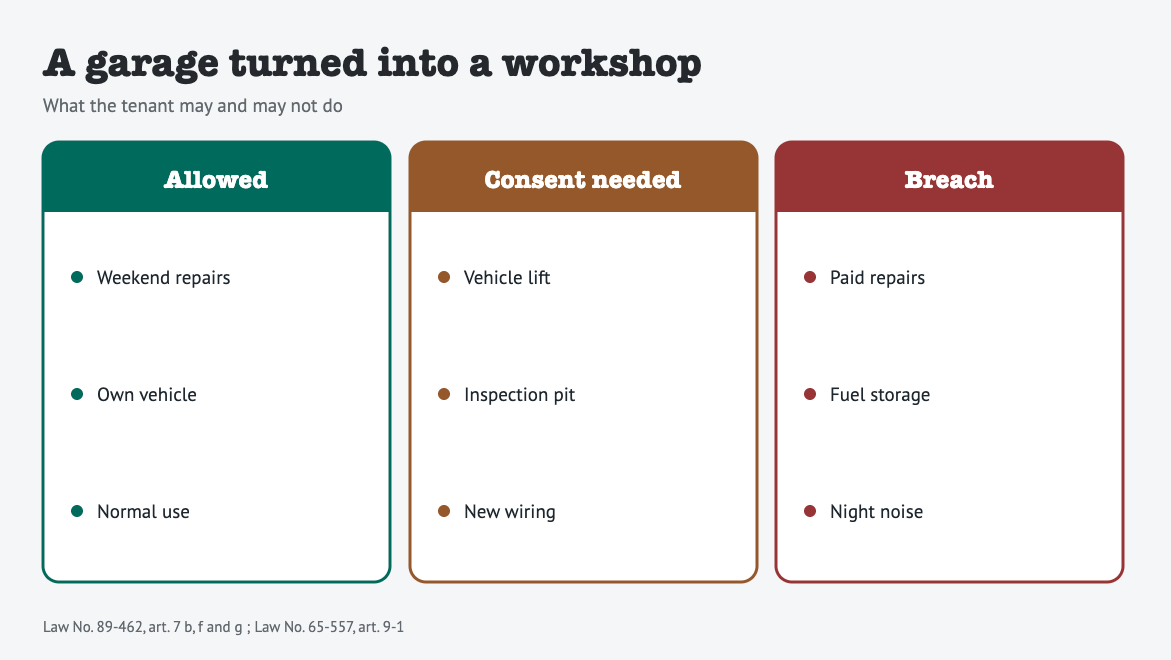
When a garage or parking space is let together with the home, it forms part of the residential lease and follows the same rules. The tenant must use the premises peacefully and in accordance with their intended purpose, and refrain from any activity that damages shared equipment or threatens the safety of residents (Article 7 b of Law No. 89-462 of 6 July 1989). Restoring a classic car on a Saturday afternoon is ordinary use. Running a repair business for paying customers, storing large quantities of fuel or working with welding equipment at night can become a breach.
Transformations are another matter. A tenant who installs a vehicle lift, digs an inspection pit or rewires the garage for heavy machinery transforms the premises, which requires the owner’s written consent (Article 7 f). Without it, the owner may require restoration when the tenant leaves, or immediately if safety is at stake.
Insurance and the risk of fire
A garage used as a workshop changes the risk profile of the property. The tenant must insure against the risks for which he is liable as a tenant and provide a certificate each year on request (Article 7 g). A fire caused by a welding spark or a fuel leak may not be covered if the policy was taken out for a simple residential garage. Owners in a co-ownership building must also insure their own liability as non-occupying owners (Article 9-1 of Law No. 65-557 of 10 July 1965).
Owners can avoid most of these disputes by describing the garage precisely in the lease and the inventory: its size, its electrical supply, the presence or absence of a water point and what it may be used for. A sentence stating that the garage is intended for parking a private vehicle and storing personal belongings gives the judge an objective reference if the use later drifts towards a workshop. The tenant, for his part, knows from the start what he can and cannot do.
Insurance also deserves a word here. A tenant who stores a car under restoration, spare parts and fuel in a garage should tell his insurer, since the risk of fire differs from that of a garage used for parking. The certificate the tenant provides each year should cover the actual use of the premises.
When the dispute goes further
If the tenant refuses to stop a dangerous activity, the landlord can ask the tenancy judge, who hears disputes arising from residential leases (Article L. 213-4-4 of the Code of Judicial Organisation), to order him to do so or to terminate the lease for breach. Before filing, it helps to identify which French court hears rental disputes for the property, since a claim filed in the wrong court wastes months. The landlord must never take matters into his own hands by changing the garage lock or cutting off its electricity to force the tenant out: that is punishable by three years’ imprisonment and a fine of 30,000 euros (Article 226-4-2 of the Criminal Code).
In Ajaccio, an owner discovered that the tenant of his villa had turned the double garage into a workshop for rally cars, with a compressor running late into the evening. After two warnings from neighbours, he instructed the firm Mon Avocat Bailleur, which sent a formal notice citing the lease and the law. The tenant moved his rally preparation to a rented unit in the industrial zone, and kept only his own car in the garage.