







When someone drives a manual car, what happens is the clutch pedal and gear stick get used together to control the power of the engine by hand, not like an automatic where gears change on their own. To know how to drive a manual car, the coordination between clutch, accelerator and gear lever has to be built up, so the vehicle can move without stalling or without jerking forward. With practice this becomes possible, and after some time, the movements start to feel automatic in the hands and feet, even though the car itself is not automatic.
Stick shift is another name people give to manual cars, because of the gear stick that gets pushed and pulled by hand. Full control over gear changes is something these cars give to the driver, which in many situations leads to better fuel efficiency, more control on hills, and better handling when the road is slippery. Enthusiasts even today, many of them prefer this kind of driving experience over automatic. For someone who is new, though, confusing is what this process can feel like in the beginning, since left foot, right foot and right hand all need to work at one time together.
Pedals and Gear Stick, What They Actually Do
Before the engine even starts, understanding what each control does is something that helps a lot.
On the far left side sits the clutch pedal, and its job is to engage or disengage the engine from the wheels. When it gets pressed down, power gets disconnected, and when released slowly, power connects again.
In the middle is the brake pedal, and the working of this one is same as in automatic cars.
On the right side, accelerator is placed, controlling how fast the engine runs.
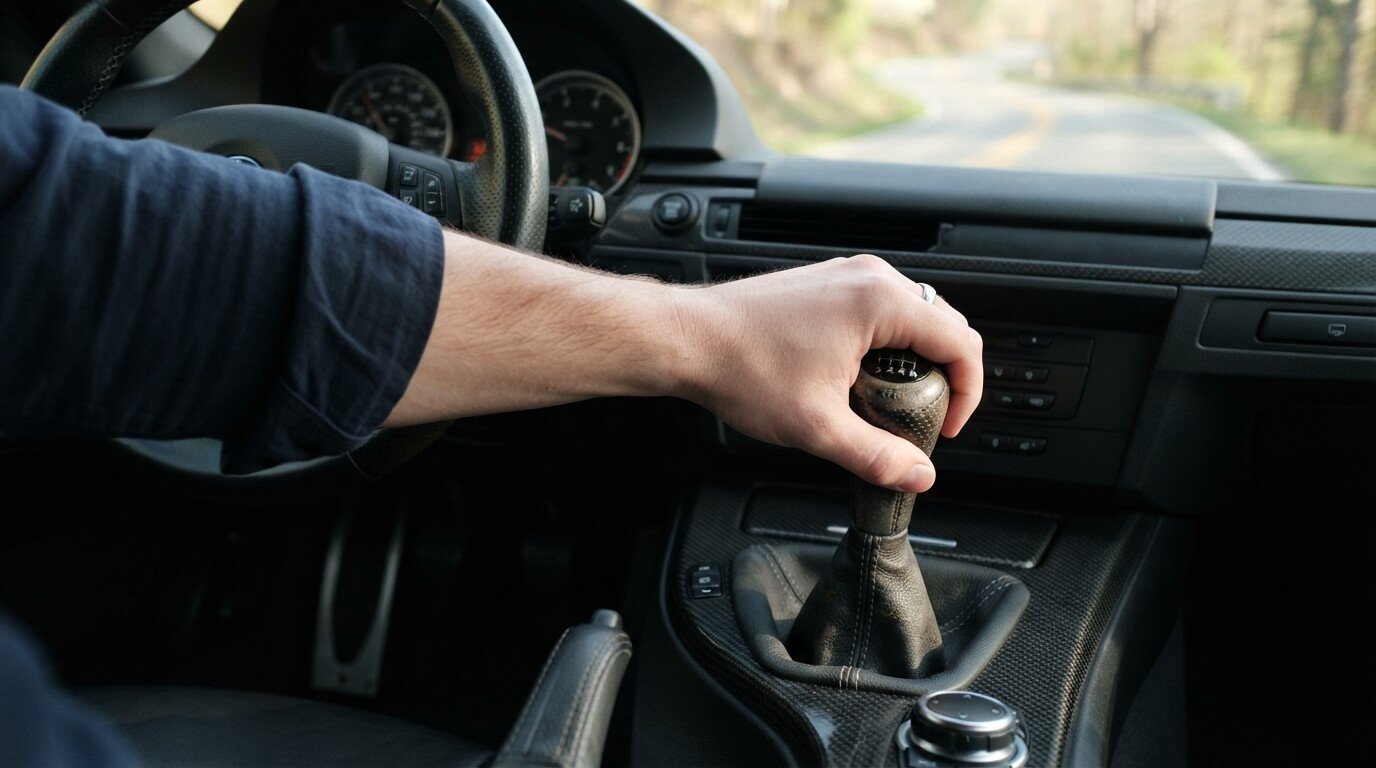
Between the seats, the gear stick can be found, and through this, gears get selected, usually from first up to fifth or sixth, along with reverse too.
Without looking down, getting familiar with where each gear sits is something worth practicing first, while the car stays parked and switched off.
Starting the Engine, then Moving Into First Gear
For starting a manual car in a safe way, the clutch pedal should be pressed all the way to the floor, with the gear stick placed in neutral. While the clutch stays pressed, the key gets turned or the start button gets pressed. Once running is the engine, the clutch pedal needs full pressing again, then first gear gets selected.
Releasing of the clutch pedal should happen slowly, while at the same time, gentle pressing on the accelerator takes place. Biting point is what this moment often gets called, which is when the clutch begins to engage and the car starts moving forward. Feeling out where exactly this point sits takes some trial and error, and during practice, stalling a few times is nothing unusual at all.
Smooth Gear Changes While the Car Is Moving
As speed goes up or down while driving, changing of gears has to happen at the right moments. Mostly, the pattern followed looks like this:
Fully, the clutch pedal gets pressed.
Into the next gear, the stick gets moved.
Gradually, the clutch gets released, while easing back onto the accelerator happens at the same time.
For higher speeds, higher gears get used, and for slower speeds or going uphill, lower gears give more power. A useful way of judging when a shift should happen is by listening to the sound of the engine, since a higher pitch usually means it is time for moving up a gear.
Stopping a Manual Car Without Letting It Stall
Timing between brake and clutch becomes important while slowing down and coming to a stop. Before engine speed drops too low, the clutch pedal should get pressed as the car slows, which is what prevents stalling from happening. Gearing down, which means shifting through lower gears while braking, helps in keeping control of the car, mainly when a full stop is close.
Once the car comes to a complete stop, neutral gets selected and the clutch gets released fully. During traffic stops or red lights, this reduces the strain that builds up in the left leg.
Why Hill Starts Feel Tricky in a Manual Car
One of the trickier skills in manual driving is starting on a slope. Naturally, the car wants to roll backward on a hill, so often the handbrake gets used for holding it in place, while power builds up through clutch and accelerator to move the car forward.
Pressing clutch and accelerator together to find the biting point is how this technique works, then as the car begins moving forward, the handbrake gets released. Confidence for real traffic situations gets built by practicing this first in a quiet spot with a gentle slope.
What Causes a Manual Car to Stall
When the engine loses power, stalling happens, mainly because the clutch gets released too fast without enough acceleration, or because the car stays in gear without enough throttle. Among new manual drivers, this is one of the most common problems faced, though no harm comes to the car itself, and restarting the engine is all that gets required.
Slowly releasing the clutch, matched with light acceleration, is the key thing for avoiding stalling. Building the right feel for the pedal happens by practicing the biting point again and again while the car stays still, before attempting to move forward on the road.
How Manual Driving Is Different From Automatic
Without any input from the driver, gears shift on their own in automatic cars, which removes the need for a clutch pedal completely. Constant coordination between clutch, gears and accelerator is required in manual cars, which gives more control to the driver, but also demands more attention, mainly in heavy traffic or while going uphill.
Adapting to automatic cars later becomes easier for many drivers who learn manual first, since a deeper understanding of how engine and transmission work together gets built through manual driving.
Practicing Manual Driving With More Confidence
Before going onto public roads, practicing in an empty parking lot helps a lot.
Rather than focusing on speed, smooth control of the clutch should be the focus.
In a low traffic area, getting comfortable with hill starts should be practiced.
Instead of relying only on the speedometer, listening to the engine helps in judging gear changes.
Occasionally stalling is simply part of learning, and worrying about it is not necessary.
Patience, along with repetition and a good understanding of how clutch, gears and accelerator work together, is what learning how to drive a manual car really takes. As practice continues, coordination starts becoming automatic, and driving a manual car begins to feel just as natural as any other skill behind the wheel.